Aviation Industry 2026: Trends, Technology & Opportunities for Aspiring Pilots
The global aviation industry is entering one of its most transformative periods. After years of post-pandemic recovery, 2026 marks a decisive inflection point—driven by fleet modernization programs, evolving regulatory frameworks, and an unprecedented demand for qualified flight crew. For aspiring pilots and aviation professionals, understanding these macro-level shifts is not just informative; it is strategically essential.
Fleet Expansion and Order Backlogs
Both Boeing and Airbus have reported record order backlogs exceeding 13,000 aircraft combined. Airlines worldwide are aggressively replacing aging narrow-body fleets with next-generation platforms—the Airbus A320neo family and Boeing 737 MAX series leading the charge. Wide-body demand is also surging, with the A350 and 787 Dreamliner securing new orders from carriers expanding long-haul networks across Asia-Pacific and the Middle East.
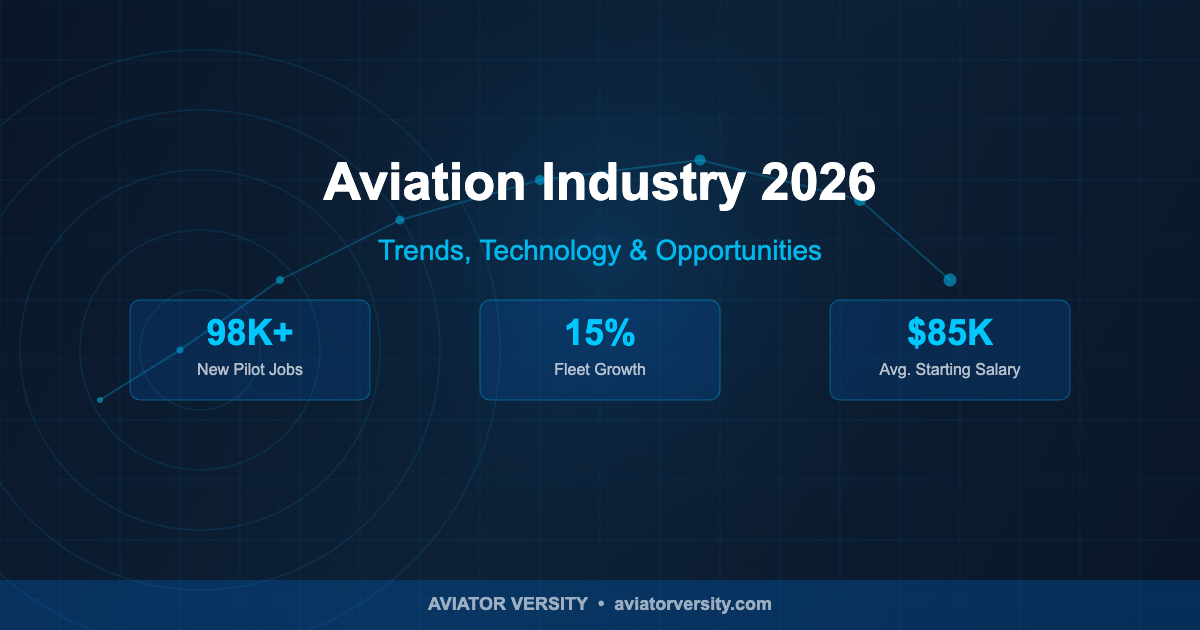
This fleet growth translates directly into cockpit demand. Every new aircraft delivery requires trained flight crew, and with global fleet size projected to grow by approximately 15% over the next five years, the pilot pipeline must scale accordingly.
The Pilot Shortage: Numbers and Reality
Industry forecasts from Boeing’s Pilot & Technician Outlook project a need for approximately 649,000 new pilots globally by 2042. In the near term, airlines across North America, Europe, and Asia-Pacific are already competing aggressively for qualified candidates. Regional carriers—historically the entry point for new commercial pilots—are offering signing bonuses, accelerated upgrade timelines, and improved compensation packages to attract talent.
The shortage is structural, not cyclical. Mandatory retirement ages, training bottleneck constraints, and the sheer volume of new aircraft entering service create a supply-demand gap that will persist for at least a decade. For candidates currently in training or considering an aviation career, the market conditions are exceptionally favorable.
Regulatory Evolution: DGCA, FAA, and EASA Updates
Regulatory bodies are adapting to industry pressures. India’s DGCA has been modernizing its examination framework, with digital testing platforms and revised syllabi reflecting current operational standards. The FAA continues to refine its competency-based training requirements, while EASA’s updated Part-FCL regulations emphasize evidence-based training (EBT) methodologies.
For ATPL candidates, this means examination content is increasingly aligned with real-world operational scenarios rather than purely theoretical knowledge. Understanding these regulatory shifts—and preparing accordingly—provides a measurable competitive advantage during type rating selections and airline assessments.
Technology in the Cockpit: What’s Changing
Modern flight decks are evolving rapidly. Enhanced Flight Vision Systems (EFVS), Head-Up Display (HUD) technology as standard equipment, and increasingly sophisticated Flight Management Systems (FMS) are redefining pilot competency requirements. Datalink communications, ADS-B mandate compliance, and Performance-Based Navigation (PBN) procedures are now baseline expectations for commercial operations.
Sustainable Aviation Fuel (SAF) integration, electric and hybrid propulsion research, and urban air mobility (UAM) platforms represent the next frontier. Pilots who understand these emerging technologies—even at a conceptual level—will be better positioned for career advancement as airlines invest in next-generation operations.
Compensation Trends and Career Economics
Starting salaries for first officers at major carriers have increased significantly, with many airlines now offering packages starting at $85,000+ annually in the United States and competitive equivalents in Europe and the Gulf region. Captain upgrades at legacy carriers can push total compensation well above $250,000. These figures represent a substantial improvement over pre-pandemic norms and reflect the acute demand for qualified pilots.
The return on investment for professional pilot training—while substantial upfront—has never been more favorable when measured against projected career earnings and job security metrics.
Preparing for the Opportunity
Success in this market requires more than logging flight hours. Airlines are increasingly selecting candidates based on comprehensive competency profiles: technical knowledge, CRM skills, situational awareness, and demonstrated commitment to continuous learning. Structured ground school preparation, particularly for ATPL theory examinations, remains the foundation upon which operational careers are built.
At Aviator Versity, we provide comprehensive question banks and practice resources designed to help aspiring pilots master the theoretical knowledge required by DGCA, FAA, and international regulatory standards. Our structured approach ensures you build the deep understanding that examiners—and future employers—expect.
The aviation industry in 2026 is not just recovering—it is actively expanding. The question for aspiring pilots is not whether opportunities exist, but whether you will be prepared to seize them.